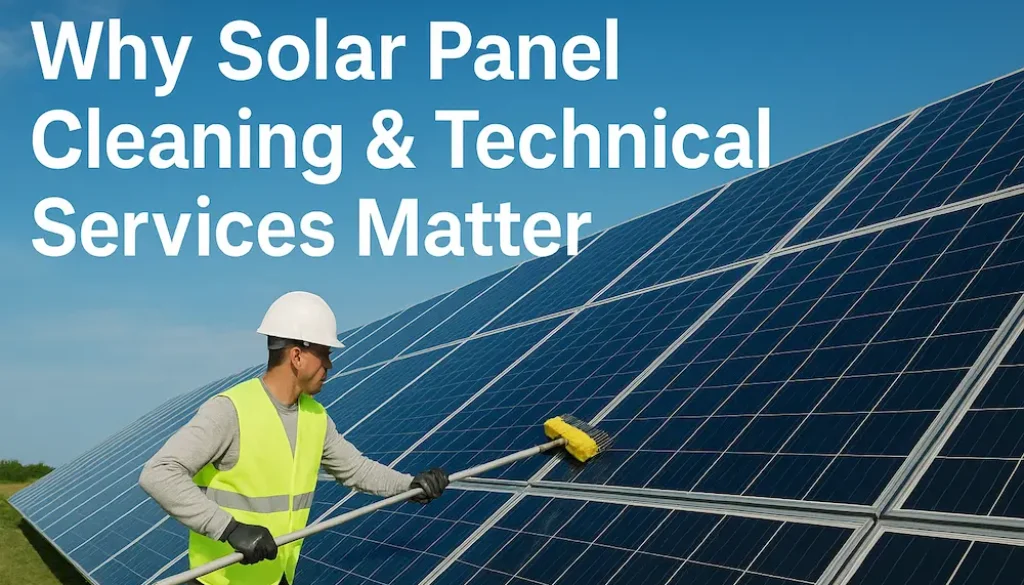
Why Solar Panel Cleaning & Technical Services Matter
When you invest in a solar power system, the panels themselves are just one piece. You need ongoing maintenance, cleaning, and technical care to get maximum return. Over time, panels collect dust, bird droppings, pollen, leaves, and grime — this accumulation is known as soiling. Soiling blocks or scatters sunlight, reducing the system's ability to convert light into electricity.
In many real-world settings, dirty panels can lose 5-25% (or more in extreme cases) of their output depending on the environment and how long dirt accumulates.
Thus, regular cleaning and proper technical servicing are not optional — they protect your return on investment, maintain warranties, and ensure system longevity.
Key Benefits of Regular Cleaning & Technical Maintenance
- Maintain Efficiency & Power Output
Cleaning removes obstruction so panels can capture as much sunlight as possible. Without it, output can degrade significantly over time. - Prolong System Life & Prevent Damage
Accumulated grit or moss can scratch surfaces or create hotspots. Over time, this can lead to microcracks or degraded module performance. - Protect Warranties & Compliance
Many solar panel manufacturers or installers stipulate that maintenance and cleaning must be done periodically as a condition of warranty. If you neglect this, warranty coverage may become void. - Reduce Long-Term Costs
While cleaning has a cost, letting your system degrade can lead to larger repair or replacement expenses. Regular servicing (electrical checks, tightening, inspections) catches problems early. - Automated & Smart Cleaning Innovations
Newer technologies, such as automated cleaning systems or drones, reduce manual labor, ensure timely maintenance, and optimize performance continuously.
How Often Should You Clean Solar Panels?
There's no one-size-fits-all answer — the ideal frequency depends on several factors:
- Climate & Rainfall: In regions with frequent rains, much of the dust may be naturally washed off. But during dry seasons, accumulation intensifies.
- Local Environment: If your panels are near roads, factories, construction sites, or dusty fields, dirt accumulates faster.
- Angle & Tilt: Steeper panels shed debris more easily. Flat or low-sloped panels collect more dust.
- Type of Soiling: Bird droppings, tree leaves, and algae require more frequent or careful cleaning.
- Monitoring Data: Using output monitoring, if you notice performance drops beyond expected seasonal variation, that signals that cleaning or inspection is needed.
Generally, many experts recommend 1–2 cleanings per year in relatively clean regions, more frequently in dusty or polluted settings — sometimes every 3–6 months.
However, novel detection systems are emerging — for example, research suggests using sensors and image processing (AI) to monitor dust accumulation levels and alert when cleaning is needed.
Best Practices & Technical Considerations
To get safe, effective cleaning and servicing, consider these important practices:
- Use Soft Water & Gentle Methods
Use deionized or soft water and non-abrasive brushes or squeegees. High-pressure jets or harsh detergents may damage panels or coatings. - Avoid Cleaning in Midday Heat
Cleaning when panels are hot can cause thermal stress (sudden cooling), glass cracking, or water spots due to rapid evaporation. Best times: early morning or late evening. - Follow Safety Protocols
Panel array roofs can be slippery and dangerous — always use proper safety gear, harnesses, and trained personnel. DIY cleaning can void warranty or risk injury. - Perform Technical Inspections During Cleaning
When cleaning, technicians should also inspect wiring, junction boxes, fasteners, clamps, seals, inverter performance, and look for signs of overheating or damage. - Automated & Robotic Systems
Several solutions exist — robotic cleaners, rail-mounted systems, or even drones (e.g., a drone developed in India that can clean a 1 MW plant in 30 minutes) — to reduce labor cost and timing issues. - Anti-soiling & Self-Cleaning Coatings
Some panels now integrate hydrophobic or dust-repellent coatings. Others are experimenting with electrostatic dust-repulsion systems. - Monitoring & Analytics
Use data analytics and soiling estimation algorithms to detect when a performance drop is due to dirt vs. other faults.
Recent Innovations & News
- A startup in Nagpur, India, developed a drone capable of cleaning a 1 MW solar plant in just 30 minutes using clean water, which reduces cost and improves efficiency.
- Academic research proposes AI-based detection of dust and bird droppings, using light obstruction metrics or cameras to signal cleaning schedules.
- In the Kerala solar sector, there's a slowdown in rooftop deployments due to policy changes (net metering caps, grid charges), which makes optimizing output from existing systems increasingly important.
- Soiling is now recognized globally as a major yield loss factor, with some studies showing up to 3–4% annual loss if not managed properly.
Why Solar Master Should Offer Cleaning & Technical Services
For a solar business like Solar Master in Kerala, adding solar cleaning and technical maintenance as a service is not just value-add — it's essential:
- It ensures clients' systems continue to deliver optimal performance, which strengthens your reputation and referrals.
- It provides recurring revenue (maintenance contracts) beyond just one-time system installations.
- In a market facing tighter regulatory or grid constraints, every watt counts — customers will value optimization.
- You can deploy or test newer technologies (robotic cleaners, sensor monitoring) to reduce manual costs and scale.